Hey there 👋 , I’m a self-taught developer from the Cajun prairies of Louisiana with a background in Industrial Design & People Management. I made the leap into software development in 2019 and havent looked back since! When not at my computer, I am usually spending time with my family, reading, gaming, or creating ambient & electronic music.

Jordan Vidrine
Leader | Designer | Developer
Analyze this...
A couple weeks back, I stumbled upon this video from Dia, the people behind Arc Browser (rip). In the video Chris Paik quickly shows a skill he created based on an article by Graham Duncan called "What's going on here, with this human?". I found it pretty interesting and thought it would be a nice way to test creating my first Claude Skill.
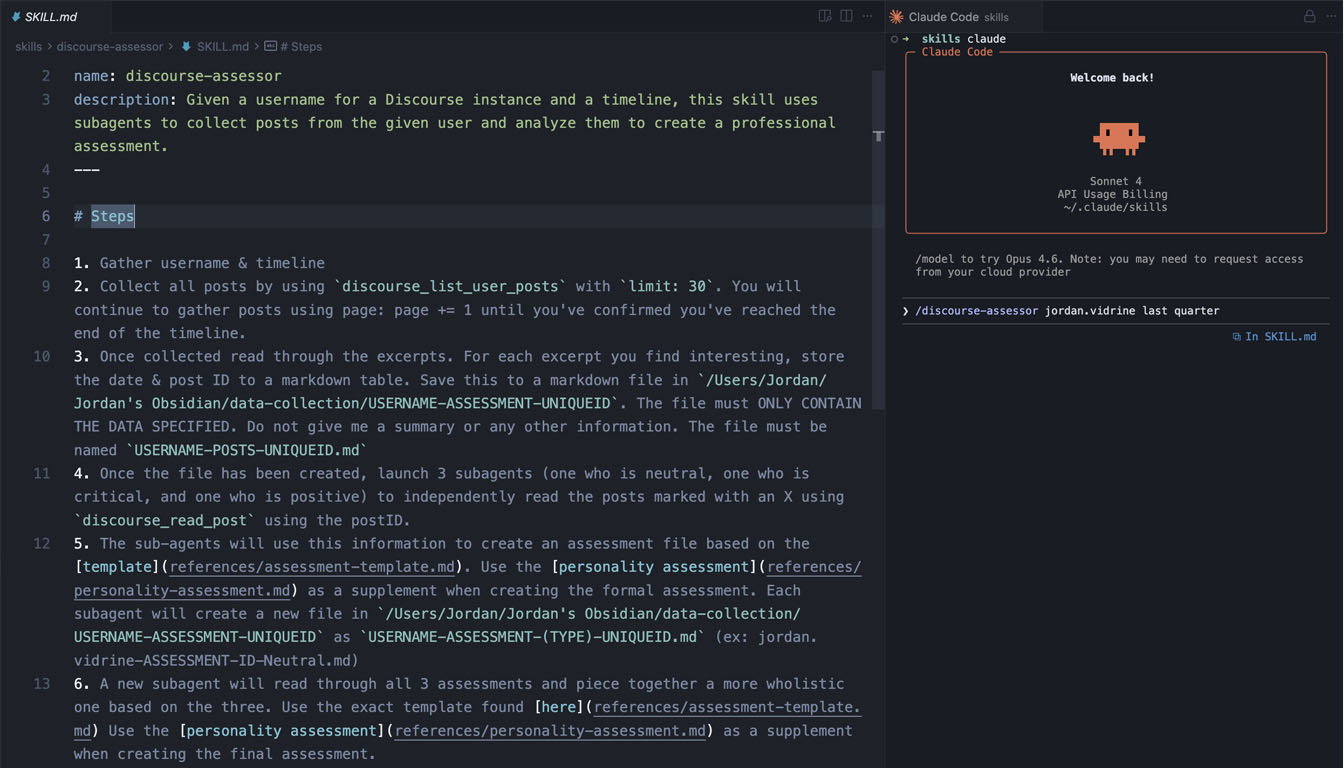
Here is my skill description in the skill.md file
Given a username for a Discourse instance and a timeline, this skill uses subagents to collect posts from the given user and analyze them to create a professional assessment.
How it works
The skill will use an mcp server to read posts from a given user over time. It then analyzes the excerpts of these posts to determine if it is interesting or not. For the posts it deems interesting, it will dive further to read all of the content in order to have a fuller understanding of what's going on.
In addition to only reading interesting posts, the skill also makes use of subagents. Once the content is loaded up, I deploy 3 subagents to analyze the content and write up their own assessments. Each subagent is tasked with a different take: a positive outlook, a neutral outlook, and a critical outlook.
Lastly, I deploy one final subagent to read through the 3 assessments and form a well rounded opinion using the opposing viewpoints.
Working on this project helped me learn that...
Context is key
In the early development of this skill I was becoming frustrated with how varied the results were. Sometimes I'd get a great assessment, and sometimes Claude would just stop working. It turns out, I was just eating up way too much context. Specifying the subagents to only read interesting posts, along with spinning out subagents for each type of assessment drastically reduced context load.
Keep the human elements a part of the process
Analyzing only a certain timeframe of content can produce varied outputs. It's also highly dependent on the conversations taking place during the specified time frame. Even with the different subagent prompts, the assessments usually take too hard of a stance in my opinion. This, along with AI's ability to incorrectly summarize, confirms it's best to use tools like this as a kickstarter to real conversation, not a full on assessment.
In conclusion
I really enjoyed working through this. It's super easy to use, and a fun tool that I'll most likely use as a conversation starter during 1:1s or annual review documents.
I'll go ahead and share the results of my own personal posts from the last 90 days on our internal work forum.
Jordan Vidrine's Assessment
Period: 2025-10-09 to 2026-02-06 (120 days)
Posts analyzed: ~155
Date of assessment: 2026-02-06
TL;DR
Jordan is a design manager who leads with taste and interpersonal care, operating as a bridge between craft and coordination at a product company navigating a turbulent period of layoffs and reorganization. His greatest asset is the combination of genuine aesthetic sensibility with managerial empathy; his greatest liability is a tendency to spread attention across too many fronts while occasionally letting important IC threads stall.
Game Being Played
Raising the floor of design quality across Discourse while building a design culture that compounds through collaboration, not individual heroics. Jordan appears to be pursuing a long-game objective: make design a first-class organizational capability rather than a service function. He wants design to be involved earlier, consulted more naturally, and for the team to challenge one another in ways that elevate the product. This sits alongside a personal objective of being the kind of manager who gives structured, caring feedback and shields his reports from organizational noise while still being transparent about business realities.
Rider vs. Elephant
Rider (conscious narrative): "I am a design leader who balances hands-on craft with people management, advocating for quality, simplicity, and design's seat at the table. I care deeply about my team's growth and the product's visual coherence." Jordan tells himself he is a thoughtful, principled manager-craftsperson who makes space for collaboration and brings order to ambiguity.
Elephant (core drives/compulsions): What actually moves Jordan is a deep need for coherence -- visual, organizational, and interpersonal. He is bothered by imbalance (misaligned spacing, unclear team mandates, meetings without agendas, excess complexity in customer communications). He also has a strong relational drive: he wants to be liked and trusted by his team, and the weekly updates with family photos, personal milestones, and gratitude suggest someone for whom belonging and warmth are non-negotiable emotional needs. There is also a detectable competitive edge -- he wants design to matter more, and he advocates assertively when he feels design is being bypassed or undervalued.
OCEAN Snapshot
Openness: High - Explores new tools (Claude skills, Cursor, chroma.js color systems), writes blog posts, experiments with homepage builder POCs, shares music, builds personal themes for fun, and engages with AI/LLM security implications. Curious across domains.
Conscientiousness: Moderate-High - Produces detailed weekly updates, creates structured review processes, maintains meeting agendas, and pushes for naming conventions and CSS variable standards. However, there are signs of overcommitment -- tasks sometimes stall ("lots of catching up to do"), weeks get scattered, and some IC work gets deprioritized under meeting load. The intent is high; the execution occasionally buckles under breadth.
Extraversion: Moderate - Enjoys pairing sessions, calls, and in-person meetups, but also values focused IC time and gets drained by excessive meetings (8.5 hours in one week was noted as unusual and heavy). Comfortable sharing personal life in public updates but does not dominate conversations -- often asks questions rather than declaring positions.
Agreeableness: Moderate-High - Gives feedback diplomatically ("take it or leave it"), frequently affirms colleagues, acknowledges his own mistakes openly (the team allocation misstep), and mediates between conflicting parties (Charlie/Kris co-ownership). However, he is not a pushover -- he will push back firmly on meetings without agendas, publicly question the value of AI testing tools, and argue against customer hour-tracking transparency when he believes the team's position is right.
Neuroticism: Low-Moderate - Generally emotionally stable and optimistic even during layoffs ("I am hopeful of the plan and path forward"). Shows some stress signals under load and admits to being "bothered" by visual imbalances. Self-describes as having ADHD, which may contribute to the oscillation between high-energy engagement and occasional difficulty sustaining focus on single threads.
MBTI Type Guess
ENFJ: Jordan leads through interpersonal influence and values-driven design vision. He organizes people, creates structured feedback processes, advocates for collaboration, and generates energy through pairing and meetings while also being capable of deep craft work. He prefers Intuition over Sensing -- consistently pulling conversations toward principles ("why" over "what"), larger visions, and systemic improvements rather than getting lost in implementation minutiae.
Enneagram Type Guess
Type 1w2 -- The Advocate: Jordan's core motivation appears to be making things right -- visually, organizationally, and interpersonally. The One fixation shows in his attention to consistency (spacing, variable naming, color systems, meeting agendas, process documentation), his discomfort with "messy" states, and his willingness to voice when something is not up to standard. The Two wing is evident in his warmth toward direct reports, his structured annual review process designed to help people grow, his openness about family life, and his instinct to advocate on behalf of his team's concerns (customer hours, team allocation, tool quality). Under stress, the One can become overly critical or rigid about how things "should" be; in health, the One-wing-Two channels their standards into genuinely helpful service to others, which Jordan mostly does.
Stengths & Weaknesses
Aesthetic Taste and Attention to Detail
Strength:
- Catches visual imbalances others miss
- Notices font weights, spacing, animation jankiness, and color contrast issues
- High standards for visual quality
Weakness:
- Can become perfectionistic about polish at the expense of shipping
- May slow teams down by surfacing small visual issues in late-stage reviews
- Risk of over-focusing on minor details when deadlines loom
Empathetic People Management
Strength:
- Creates thorough review processes
- Handles difficult team dynamics with care
- Openly admits mistakes and takes responsibility
- Considers individual team member needs
Weakness:
- May over-accommodate individual emotions at the expense of making decisive calls quickly
- The co-designer proposal for a new team was dropped once, then re-proposed — the initial capitulation cost time
- Can delay decisions to avoid conflict
Bias Toward Action and Simplicity
Strength:
- "A little less conversation, a little more action" mentality
- Cuts through unnecessary complexity
- Drives toward concrete outcomes
Weakness:
- Can come across as dismissive of process that others find valuable
- The instinct to simplify sometimes conflicts with stakeholders who need more information
- Risk of appearing impatient with necessary deliberation
Ten-Adjective Reference Guess
- Warm
- Principled
- Detail-oriented
- Transparent
- Collaborative
- Opinionated (constructively)
- Scattered (at times)
- Earnest
- Protective (of his team)
- Craftsman-like
Key Questions to Ask Next
-
What is the one project you most regret not finishing or driving harder over the past six months, and what got in the way?
-
If you could only do one of the following for the next quarter -- manage people or do IC design work -- which would you choose and why?
-
When was the last time you gave a direct report feedback they genuinely did not want to hear, and how did it go?
-
How do you decide when a visual quality concern is worth raising versus when shipping imperfect work is the right call?
-
What would the design team at Discourse look like in three years if everything went perfectly?
Optimal Seat
Design Manager / Head of Design at a 50-200 person product company where craft, culture, and customer impact all matter. Jordan is optimally positioned in a role where he can:
- Stay close enough to the work to maintain credibility and taste (reviewing PRs, writing CSS, building prototypes)
- Manage a small-to-medium team (4-8 designers) where personal relationships are still possible
- Serve as the design representative in cross-functional leadership discussions
- Shape design operations, tooling, and processes without being purely administrative
- Work in a product that has inherent visual and interaction design complexity (not pure B2B SaaS with simple forms)
His current role at Discourse appears to be a strong fit. The key leverage unlock would be either: (a) narrowing his attention to fewer, higher-impact initiatives driven to completion, or (b) having a senior IC or design lead beneath him who can handle more of the craft execution, freeing Jordan to focus more purely on design strategy, team development, and cross-functional influence. The ADHD-acknowledged tendency toward breadth means he would benefit from an environment -- or a partnership -- that helps him maintain focus on the critical path rather than responding to every interesting thread.